

One of my favorite things to say is, “You learn something new every day.” I don’t know how true that is, but I’m positive that I don’t know everything there is to know and it turns out that I’m reminded of that fact on a fairly regular basis (nearly daily) by learning something new. Recently I learned something new about a piece of technology that I had thought I had left in the distant past; the DSL Filter.
For those who don’t know what a DSL Filter is or what it does, you should check out this little FAQ on dslreports.com. It’s more than you ever wanted to know about DSL Filters.
This little piece of information was so…odd…that I had to do a little research on it before I finally decided to try it out. First, a little setup:
The Issue
I have a client that has a large Xerox Multifunction Printer. They do a lot of faxing from this machine, both sending and receiving. Unfortunately, about 1 in 20 faxes fail miserably. That wouldn’t hurt me, I might not send 20 faxes in my lifetime, but for this office you’re talking about 5 – 10 failures a day. This client contacted their Telephone Service Provider, who will remain nameless, and they were told that the issue is that a fax device uses Analog Signals while their phone system is strictly Digital.
I was called in to see if I could offer anything other than excuses as to why it won’t work. Thanks to my first employer; when it comes to Telecom I have a very basic understanding of it. I know how it works, I know how things should look when connected properly, and I know when something looks off. Looking in the phone closet at this client’s office, everything looked like it should for your typical Voice Over IP (VOIP) Phone Service. What I didn’t see were any Analog Lines that would have been used for a Fax Machine. I didn’t want to go to the client with the same answer as the Telephone Service Provider of, “Duh, it don’t work”.
Why It Doesn’t Work
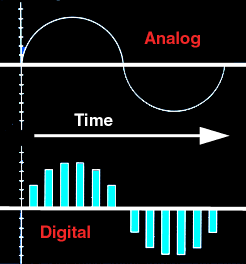 A little research into the issue gave me a more technical reason as to why this didn’t work. It also gave me my first possible resolution. Fax technology is analog; that means that the signal is continuous. It’s continuous when it’s produced and it’s continuous when it’s received. A Digital Signal isn’t continuous. When a Fax is transmitted digitally the Analog Signal is sampled at some interval and converted to 1s and 0s, Ons and Offs, and sent in data packets. If the signal isn’t converted properly then the fax will fail or some part of the data will be lost. The best possible solution is to reduce the Fax speed, this will cause more of the Analog Signal to appear in each packet of the digital transmission, it’s not perfect, but it tends to take care of the issue most of the time. Ta-Da! A solution presents itself!
Guess what this particular model of Xerox Printer doesn’t allow you to change; that would be the Transmission Speed. Back to the research.
Something New
I started seeing mentions of something called the DSL Filter Trick for taking care of this exact issue. The more I saw it mentioned but not explained, the less I believed that it would work. The trick is to take a DSL Filter and plug it into the Fax Machine instead of the Wall Jack. Then run the phone cable from the DSL Filter to the Wall Jack. I ignored the first several sightings of this craziness, but it started popping up more and more. The people that used the DSL Trick would say that it works almost every time.
I was not convinced, but I was willing to give it a shot. Mike Morgan, who shows up in these articles a lot, just happened to have a box of DSL Filters in a drawer at his house. Armed with one of these filters I went to the client’s office and plugged everything up just like I was supposed to. Part of me was expecting the Fax Machine to stop working all together. I explained to the client that this was just a test and if anything out of the ordinary started happening, then they should unplug the DSL Filter and just throw it away. Amazingly enough it’s been almost a month now and their Fax issues are completely resolved.
Why the DSL Filter Trick Works
I couldn’t just leave it at that, I had to know why this works. In my mind there is nothing in a DSL Filter that should have any effect on a Fax Machine, DSL Filters were designed to keep your Fax Machine from getting damaged by the higher frequencies of DSL Internet Service. Who in the world would think to plug it in backwards to fix a problem with Faxing over VOIP? There is nowhere that I’ve found that explains exactly why this works, at least not a single site. You can find bits and pieces on different sites and that’s what I did to put this together.
The reason that this works is that a DSL Filter streamlines the Fax Signal. It reduces that amount of information that has to be broken up and sent in the data packets by removing line noise and unused frequencies. So you have more Fax Data in each packet, just like lowering the transmission speed, but your faxes are still going out at the higher speed. Somebody is a genius for coming up with this; I just wish it was me.
If you found this article while troubleshooting a fax issue I would love to know if this helped. Leave your comments below. If you’re reading this article because you like reading what I write, then bless your heart, you can comment too.
Dennis Edmondson Jr
Computing Concepts LLC


